I will actually be working in person this weekend, so I wanted to bring a treat for my other colleagues that they could take home with them. I tried Krispy Kreme donuts last weekend; that didn't work (barely anyone took any!). So I thought cookies might be better.
I knew I wanted to make something with peanut butter because I also had a lot of cashews I wanted to use. And everyone knows chocolate goes well with peanut butter, so I looked for recipes for peanut butter chocolate chip cookies. And I found this recipe on the Crazy for Crust blog (I get the emails but rarely actually read them; I keep them all in a "Crazy for Crust" folder!).
INGREDIENTS
1/2cupunsalted buttermelted
1/2cupcreamy peanut butter
1/4cupgranulated sugar
2/3cuppacked brown sugar
1teaspoonvanilla extract
1large egg
1/2teaspoonbaking soda
1/2teaspoonsalt
1 1/4cupsall-purpose flour
1 1/2cupschocolate chips
INSTRUCTIONS
Mix or stir butter with peanut butter until smooth. Add brown sugar and granulated sugar and mix until creamy.
Beat in vanilla, egg, baking soda, and salt. Mix in flour slowly until cookie dough forms. Stir in chocolate chips.
Scoop 2 tablespoon sized cookie dough balls onto cookie sheets covered with parchment paper or silicone baking mats. Chill 30 minutes.
Preheat oven to 350°F.
Press cookie dough balls flat with the tines of a fork.
Bake cookies for 8-12 minutes, or until slightly brown on the bottom and the top just loses the wet cookie dough look.
I mostly followed this recipe, except I used a little less brown sugar, added the cashews, and didn't push the cookies down with a fork (I just left them as drop cookies). Typically I wouldn't bother putting the dough in the fridge before baking, but this dough was falling apart before it was even in the oven. I knew they'd never stay together once they started heating up! I had visions of a big, melty, peanut butter mess if I didn't follow the recipe*. In the end they didn't melt in the oven...but they didn't seem to bake either. I left them in for 10 minutes and they looked almost the same as when I put them in. They even felt kind of cool to the touch! I put them in for a few extra minutes, but it didn't seem to make a difference. I tried one cookie: it tasted good, but that's probably because it tastes like cookie dough; the inside clearly wasn't baked all the way. I wouldn't say these are a complete failure, but I might tell my friends to heat the cookies up in a microwave for a few seconds so they don't get salmonella...
Out of the blue, an old friend reached out to invite me to visit Glenstone with him. I had never heard of Glenstone, but after taking a look at the website, it's an indoor/outdoor museum of modern art. It's in Potomac, MD, so not far from me, and it looked really cool. Plus, it sounds like tickets are hard to come by: they sell out really fast months in advance. So I thought this might be my only opportunity to go! And we hadn't seen each other in a few years, so I thought it would be nice to catch up.
After a casual breakfast at Tally Ho, we made our way to the museum. While the day started out a bit cloudy and rainy, when we arrived it was bright and sunny, so we were ready to explore!
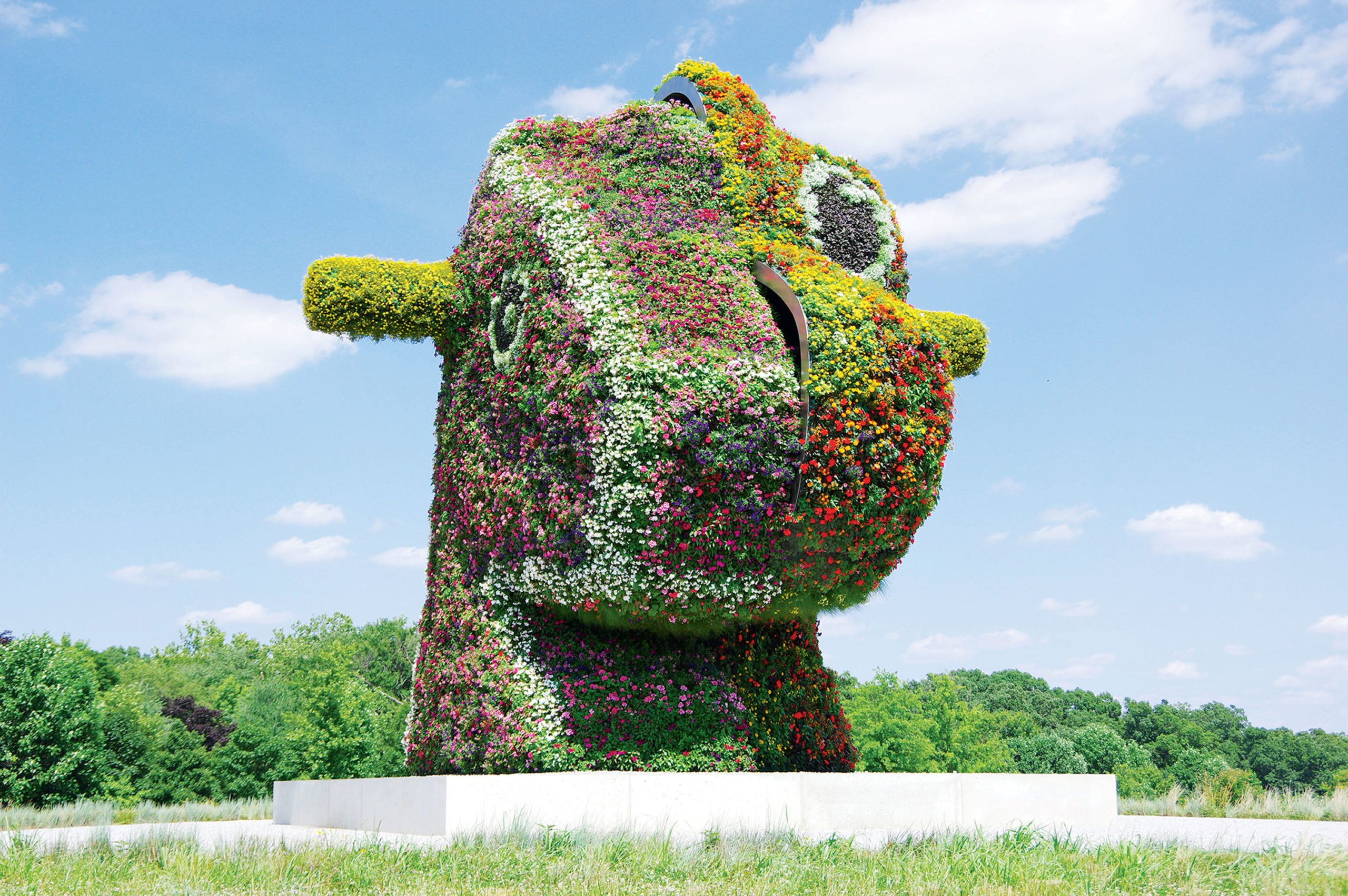
Glenstone sits on nearly 300 acres of land, and it was beautiful walking through the meadows and forests. The trees and flowers are nature's art, no? We saw the outdoor sculptures first, although there weren't as many of them as I expected (especially with so much space!). The first one we saw was Jeff Koons' Split-Rocker. We could tell it was the head of a rocking horse, but it wasn't until we got up close that we could see that it's covered in something like green felt with holes in it.
Perhaps we were too early in the spring to see this piece at its best. Because when you look it up online, there are times when it's in full bloom with lots of color! Like this:
Then we saw Tony Smith's Smug, which made both of us think of spiders:
We eventually made our way through the forest where we encountered Robert Gober's Two Partially Buried Sinks:
Needless to say, we were underwhelmed by this one. The hummingbird we saw flitting through the woods was much more interesting! Image found here.
While we were walking in the woods, we also saw two stone buildings that we didn't realize were pieces on exhibit, and there was a circle of stumps that counted as art, too. If I can't tell that it's art... it probably shouldn't be called art.
Charles Ray was very creative in naming this piece Horse and rider:
Before entering the buildings, there were two outdoor sculptures that were somewhat interesting. We could walk through Richard Serra's Sylvester (though both of us were hoping we'd come across something at its center), and Michael Heizer's Compression Line was pretty cool, slowing disappearing into the earth.
Michael Heizer's Compression Line. I took this picture looking down from a railing; the photo doesn't do a great job of showing the size of the piece, although there are the trees in the background for scale.
The Gallery building was dedicated to works solely of Faith Ringgold, an African-American artist who has been making art for decades. I really liked her work, and I think showcasing her pieces is very timely for what our country is going through regarding race relations (well, we've been going through that for a very long time, as her art portrays). My favorite pieces from her were the ones with overt political messaging, particularly with her use of the American flag. I appreciate art that has something to say!
Ringgold was against all of the money being spent on space exploration when so many African-Americans are suffering here on Earth. She included the message that she felt the U.S. government was sending in this piece: Die N*gger (a little hard to read in the photo). Image found here.
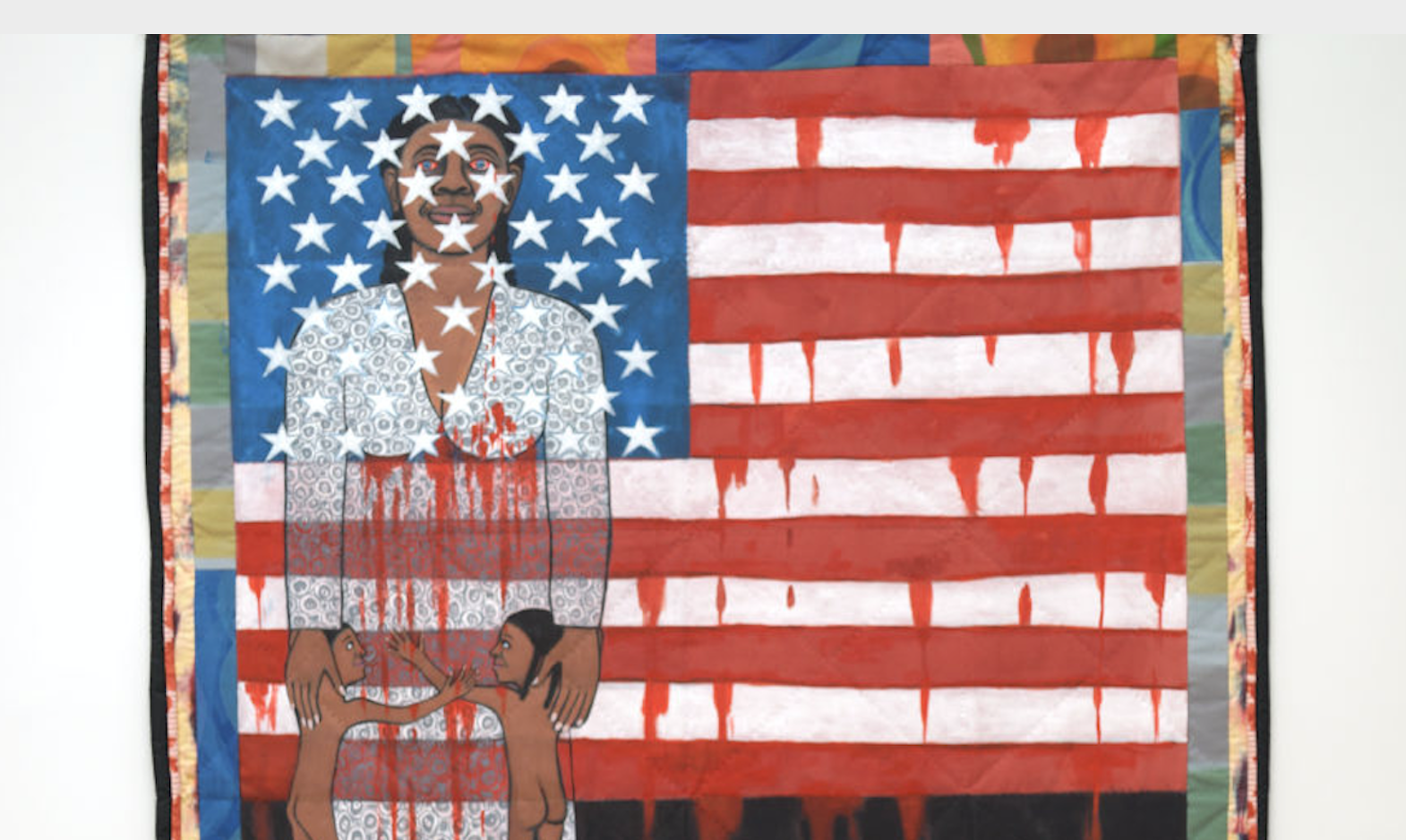
The Flag is Bleeding is one of two pieces in which she portrays the red of the flag bleeding the blood of Americans who have lost their lives seeking basic human rights. Image found here.
Ringgold also collaborated with her mother in creating quilt paintings. I really liked the one she did of Maya Angelou and her poems, including Phenomenal Woman, which is my sorority's house poem.
Maya's Quilt of Life was actually commissioned by Oprah Winfrey. Image found here.
Who's Afraid of Aunt Jemima? is an entire story quilt. I have never seen so many words on a piece of art! I didn't have time to read it all, but I thought it was interesting to mix multiple kinds of storytelling into one piece. Image found here.
This quilt featured a painting of Martin Luther King, Jr. with a quote from his iconic "I Have a Dream" speech. Ringgold created similar pieces featuring Sojourner Truth and Harriet Tubman. Image found here.
Outside of the Gallery was a patio looking over a beautiful lake. There were two Canada geese swimming in the water and a heron standing on the bank. So idyllic!
Then we made our way to the Pavilions, which are the main museum buildings. It almost seems like some sort of post-apocalyptic compound, these stone squares rising up in the middle of nowhere:
From the Pavilions we saw additional pieces from the artists who had outdoor sculptures:
Gober put sinks in the woods, and then painted interior walls to look like woods with running sinks and piles of newspapers from 1992 (when the exhibit was originally created). I wondered if this piece was supposed to represent our wastefulness of resources, just letting the water run and killing trees for newspapers to the point that we have to paint trees on our walls to see them...? Image found here.
Heizer's Collapse was enclosed in these exterior walls. A crane had to lift the steel beams and place them into the 16-foot-deep hole. Visitors have to view the piece with a docent so no one falls into the hole. I wasn't sure if this looked like anything other than a broken-down, abandoned construction site... Image found here.
Here were some of my favorites:
My friend and I loved these hanging sculptures from Ruth Asawa. How was she able to interlock those different chains together to create shapes within shapes? Screen shot from here.
I thought this map by Alighiero Boetti was really cool, since he represented each country with the colors of its own flag. I couldn't identify some of the countries, and of course the spacing is off (when you flatten a globe, you can't see just how close Alaska is to Russia). But I will say that when I was looking up his other work, he has made A LOT of similar pieces. I can understand wanting to show new countries that are created or borders that have changed, but he must have made at least a dozen of these. So now I'm less impressed... Image found here.
This photo doesn't do justice to this piece by Ives Klein. I liked it because of its tactile nature. The sea sponges and pebbles painted blue brought interest to a canvas painted one color (more on that later...). Image found here.
These neon lights are hard to read in a photograph (see this drawing instead), but Bruce Nauman's American Violence demonstrates the sexual violence of our culture all wrapped up in a swastika. In person the words would go in and out, and you could image mixing up the phrases together (e.g. "Rub it on" could go both with "my chest" or "my face"). American culture is hyper-sexualized, and as we've seen recently, Nazi sentiments/sympathizers still exist, and if anything the numbers are growing. Image found here.
I really liked this piece by Kazuo Shiraga. For me it was the fact that I wanted to touch it: the paint was so thick and the canvas was folded and scrunched in places in a way that made me want to run my fingers along the work and know what it feels like. Of course you can't do that in a museum! Image found here.
Some pieces we didn't get to see. Because of COVID restrictions, some rooms were closed, and only one party at a time could go into each of the smaller rooms. There was a group of teenagers who had zero respect for people's time, and they lingered in the rooms fully aware that there were people waiting to get in. For example, they sat in this room for who knows how many minutes:
So I just snuck in for a peak to see that one. There were other pieces that my friend and I had plenty of time to linger upon, but we didn't because they were the kind of pieces that give modern art a bad name. Here are some examples:
These paintings by On Kawara represent the dates of the moon landing. But how is this art...? Image found here
This piece by Brice Marden is called Moss Sutra with the Seasons. I understand how the different colors can represent the four seasons, but painting a square a single color is the cliché of modern art. Image found here.
These Jo Baer paintings only have color along their edges. WHY?! Image found here.
The museum's notes didn't say how old Jean-Michel Basquiat was when he painted Frogmen. I guessed 10; he was 23. Close enough. If this is fine art, then every child should be getting commissions. Image found here.
Marcel Duchamp's Fountain (i.e. a urinal). I will admit that I consider toilets art when I watch The Great Pottery Throw Down on HBO Max, but that's because they have painted them so beautifully or have created them in an interesting shape. This guy laid a urinal horizontally and painted someone else's name on it. I just...can't. Image found here.
Franz Kline... you're killing me. Why am I not famous?! Image found here.
Agnes Martin used graphite (i.e. a pencil) to draw who knows how many lines in her piece Pilgrimage. I told my friend that anyone with a ruler and a lot of patience could recreate this. Image found here.
The outdoor experience was definitely my favorite part. The Pavilions surround a water feature where we saw irises, tiny fish, and even a tadpole!
When we went the lily pads weren't in bloom yet. I wondered which plants were purposefully planted there and which ones were growing naturally. Image found here.
All in all, I really enjoyed my visit to Glenstone. Modern art isn't really my thing, but I appreciated the grounds especially, and some of the pieces were actually really cool. I would love to go back, but with the ticket situation, I'm not sure when that will be. I would be just as happy to just walk around the outside! I was telling my friend that Glenstone should take advantage of the beautiful land and provide private bird walks early in the morning before the museum opens. We saw two hawks along with the other birds I mentioned earlier. I'll take the beauty of nature over human-created art any day!
I attended the Bethesda Film Fest years ago, and I hadn't thought about it recently until I received a Bethesda Beat email containing a link to watch some selected films from the festival. All were short documentaries, which are actually some of my favorite to watch, since film festivals are usually the only time you get to see stuff like that (read my take on this year's DC Environmental Film Festival). There were seven in total, and I enjoyed all of them!
I am not sure if this year's festival had a theme, but one thing that really occurred to me was how many of these short films highlighted the issues we have in the United States, a country that is supposed to be the Land of Dreams, a nation that other countries do (or at least used to) look up to as a democracy. Let's take a look at those first.
*Full film (~10 minutes)
West Virginia - COVID and Hunger Collide
In West Virginia, people were already struggling to make ends meet when the coal industry was no longer booming like it used to be. Add a pandemic to the mix, and an even greater number of people were losing jobs and going hungry. The film shows how hard working Americans are not able to feed themselves and their families because the jobs cannot pay well, even to those who are educated or skilled. The film goes into the the issue of the middle-class: if someone makes too much money (even with as little as a $.50/hour raise), that person would lose government benefits that they still depend on; by making more money, they're even less able to provide for themselves and their dependents. A representative from a local food pantry went into detail about how difficult it was to give enough food to those in need before the pandemic, and how COVID pushed even more people into desperation. It astonishes me that America, the Land of Plenty, cannot feed all of its people when grocery stores across the nation are full of food and so much ends up going to waste.
Squeegee
This film looked at the young men in Baltimore who wash car windshields when they're parked at red lights to make a living. Most (none?) of them are doing this as additional income: this is the main way they make money to take care of themselves. It was heartbreaking to hear the stories from men who got into trouble when they were young and now find it difficult to get hired from a job, or from the boys who are only 13 or 14 years old who do this because their parents cannot provide for them. These men do this when they cannot be hired for other work, and they wish to avoid selling drugs and panhandling to support themselves. The scenes showing worn-down buildings in Baltimore and graffitied walls don't look like something that should be in such an historic city just an hour away from our nation's capital, and yet Baltimore is a city that is riddled with poverty and violence. I wish that these men would have opportunities to education and work that could give them a brighter future, rather than depending on the random kindness of strangers just to be able to feed themselves.
You Think You Know Me
This film is mostly a montage of scenes of police violence against African Americans, the protests in response to such violence, and the photos and names of the men and women who have lost their lives at the hands of police. Some of the names most of us are familiar with, like George Floyd and Breonna Taylor, but others have gone under the radar. All of these deaths are tragedies, and they were 100% preventable. The police are supposed to help protect people, but for the African American community, the police are NOT the people you turn to for help in fear of being arrested, or worse, killed. I don't know what the answer is, but I believe there needs to be immense police reform, particularly regarding bias training, and that our police force needs to be demilitarized. The police should not need tanks, tear gas, and machine guns to protect its people; those tools are specifically made to do damage and kill. This sort of systemic violence should NOT happen in a place like America, and yet it does, nearly every day, for hundreds of years.
The Good Candidate
Last year, Bob Good and Denver Riggleman were running against each other in Virginia's fifth district to be voted as the Republican candidate to move onto the next election. Riggleman was seen as a "purple" Republican, meaning he had more centrist ideas, which many felt did not represent this very red district. The main complaint again him was that he officiated a biracial, gay wedding; many of his constituencies felt he did not represent their values in supporting gay marriage. One of Bob Good's ardent supporters made a video in which he said that members of the LGBT community were trying to take away the rights of those with Judeo-Christian ethics. While Good doesn't blatantly agree with this man, the candidate doesn't condemn the man, either. In the end, Riggleman lost the race to bigotry. It's so disappointing to live in a country in which people believe that giving a group of people rights (the same rights that white, heterosexual Americans have) will impinge on the rights of others. Giving the LGBT community and non-white Americans rights doesn't mean anyone else would lose their rights: we would all be more free and equal under the law!
A Mirror of the Earth
This film was about Spain, not the United States, but the issue of water pollution and toxicity reaching local communities is definitely one that America can relate to. A corporation came in for mining, and when it left, toxic waste remained that polluted the drinking water; the mining itself created air pollution, too. Cancer rates in both children and adults are higher in that area. The issue of environmental justice is not new: the haves take from the have-nots, and leave the have-nots worse off than they were before. And what's terrible about environmental degradation is that it can happen so quickly yet have results that last decades, even centuries. This film mentions an ancient cave that was discovered due to the mining, and human bones were found there; humans had lived in the area for hundreds of years, and yet with the destruction of recent times, the place may be uninhabitable in the near future. We only have one Earth: why do we insist on destroying its future for our immediate gains?
To uplift the mood, there were two films that were more inspiring in a positive way:
*Full film (~6 minutes)
Shi Fu Paul
This film is about Paul Jakubowski, a
Lipstick and Leather
I never knew what
"alternative drag" was until watching this film. There is a drag
scene in Baltimore (and sometimes in DC) that allows men to dress in drag, but
in a alternative, grungier way. The film follows a few of the performers, and
we learn about how they got into drag, what their drag character is like, and
what the alternative drag scene means to them and their identities. I always
enjoy watching films about things I don't know about, and I'm glad that there
is a space like this for those who want to explore it. This was one of the more
hopeful films since it shows the kind of acceptance that I wish our society had
for all people.
I know friends who have used Hello Fresh to help with meal planning and to give them new ideas for cooking. My parents recently signed up for it, too, and I cooked one of the meals last night. I have to say it: I was not impressed.
First of all, the amount of overpackaging is staggering. All of this is just for one meal. Imagine how much trash you would have if you did Hello Fresh for all three meals, every day, for a month or longer! A lot of it is stupid stuff, like a packet that contains just a teaspoon of paprika, or those plastic tubes of mustard and mayonnaise like you would get from a fast food joint. I understand the idea of wanting to make sure the user has all of the ingredients, but don't most people have condiments in their homes? The recipe assumed that I had access to water, oil, and salt and pepper; what if I didn't? It doesn't make sense to assume a user would have some ingredients and not others.
Here's an idea: a Hello Fresh "start-up" kit. Included with you first order (not for free, but part of the total charge) would be large quantities of basic ingredients that would be used in many of the company's recipes. This would include condiments, spices, salad dressings, sour cream, etc. And they would come in recyclable packaging so when you're finished, you're not just dumping everything into the landfill!
Now onto the recipe itself. It's hard to read in the photo above, but the second step should be the first one. The potatoes take the longest amount of time to prepare, so they should go first! Also, I was given tiny potatoes for potato wedges...It's hard to make a wedge out of something that's already small! And frying the fish was a mess! Oil splattered everywhere while attempting not to burn myself. In the end it wasn't even enough oil, so the breading on the last piece of fish was completely burned off. I was also surprised that there's a explanation of how to make a salad. Like, really? (and can I add that some of the mixed greens were already going bad; gross!). Plus, this recipe called for putting shallots in the salad. No thank you! So I saved those for scrambled eggs in the morning. And only one of the quarters of lemon is actually used in the written recipe; why even bother and just save the fruit for something else? And while the recipe does say on the left what you'll need in terms of tools, it never states just how many plates/bowls/cutting boards you get dirty during this recipe. I feel like I could have filled up half the dishwasher just from making and eating this one meal!
In the end, the food was good, but not worth the trouble. I thought the idea of Hello Fresh was to make cooking easier, but I didn't find that to be the case. It took longer to make and made a bigger mess than anything I would just cook on my own. And when I make my own recipes, I don't create nearly as much waste. I'm glad I made this using my parents' Hello Fresh account instead of making my own account and spending my own money on this!
Since I was working for The Nature Conservancy (TNC), I have been aware of the D.C. Environmental Film Festival. I try to go to at least one screening a year (although sometimes even that didn't happen). Of course this year the festival was virtual. At first I thought I wouldn't bother to watch: why would I want to just watch movies on my computer when I used to be able to make an event out of it and go to a theater in the "before times" ? But we're still in a pandemic, and since I'm stuck at home watching a lot of TV anyway, I figured I should at least make sure I'm watching something educational.
Even though I had a few binge nights of EFF movies, I couldn't possibly watch them all. I mostly watched shorts, which was especially conducive for quarantine watching since I could watch a little bit here and there between doing other things. I'm not sure how many I watched in the end, but the list is too long for one blog post. But here are some of the films I watched, categorized under the very fancy labels of "good" and "bad." Let's start with the bad first (just to get them out of the way).
BAD
Ain't Your Mama's Heatwave
Comedy is already subjective: what one person finds funny, another person thinks is dumb. But I think we've all seen amateur comedy, and all of it is pretty bad. The comics featured in this special were no exception. First of all, I was disappointed by the lack of climate-related bits that were in the routines. The whole idea of the show was to address the important issue of climate change, but each comic really only referred to it once, mostly regarding sea level rise (which of course is one impact of climate change, but it's not the only one). Then most of them didn't have great stage presence or a good rapport with the crowd; one of them kept calling the audience "stupid" and telling them to shut up! That's not the kind of show I want to watch, getting berated by a C-level comic! Most of this show wasn't funny, and since it was the first film I watched during the festival, I didn't have high hopes for the rest of the films. Luckily the rest were much better!
I watched this because I think cormorants are cool, and Cormie is such a sweet name! But the film was mostly about trying to teach a cormorant to take dollar bills with her beak as a ploy for donations. Don't get me wrong: the Wildlife Center of the North Coast is doing great work to help save animals. But a short film about the inability of a bird to grab a dollar bill in her beak and put it into a box doesn't really make for a good story. Also, the film shows the executive director handing out branded tote bags to possible supporters, most of the time giving them more than one; if you need donations, why not charge for the bag? Even just $1!
Mother of the Air
I couldn't watch this short film all the way through. It's just a voiceover of a mournful song as you watch the burning forests of the Amazon. Of course the destruction of this beautiful natural resource is devastating, but it doesn't mean I need to watch it for 10+ minutes.
The Whelming Sea
I was interested in watching this short film because it was supposed to focus on horseshoe crabs, a species that I have seen myself on the beaches of Delaware. But the film itself wasn't that good. Most of the footage was shot at night, so you can barely see anything. A lot of the dialogue is hard to hear; you're not even sure what's going on. There must be better films out there to highlight the importance of these ancient animals.
GOOD
Aguilucho: Dance of the Harpy Eagle
I did not know Harpy Eagles lived in Panama; actually, I'm not sure where I thought they lived. But it was really cool to see how the local people of the Darien Gap rainforest are helping to protect the birds and use their conservation as part of eco-tourism. The footage of the birds is beautiful, and the people interviewed are so clearly dedicated to protecting these rare birds.
America's Heartland: Wild Prairie Reborn
This film is about the plight of the American bison and how the animals are being protected on Montana's American Prairie Reserve. These amazing animals are necessary for grassland ecosystems, and their numbers have been decimated ever since pioneers moved out west. When I worked for TNC, I actually had the opportunity to see bison in their natural habitat in Illinois, where the organization had helped bring them back to those grasslands. It was amazing to watch these large animals move as a herd, at times disappearing completely behind rolling hills. As America's national mammal, I hope we can continue to protect the bison for generations to come.
Again, I knew what ocelots were, but I didn't know they lived in the U.S.! This documentary was about studying these cats in Texas, and finding ways to protect this critically endangered species. Plus, who wouldn't want to watch a film about these cute cats?!
Citizen Nobel
I REALLY liked this film! It follows Jacques Dubochet once he won the Nobel Prize in Chemistry in 2017. He is such a down-to-earth man, and yet clearly he has some genius in him. You want to know the guy in real life! He is humble, funny, and so passionate about protecting our planet for the future. I would never have learned about him otherwise, so I'm so glad EFF included this film in this year's festival!
*Full film (~10 minutes)
Dive Tierra Bomba Dive
This film follows a young woman from an island in Colombia who is passionate about diving and protecting the ocean, especially the local coral reef. I'm always impressed by young people who start early in trying to make the world a better place. She wants to go to college to study marine science and works with the local fishermen and others to empower the community to protect their reefs and therefore their fishing livelihoods. You go, girl!
*Full film (~24 minutes)
From Kurils with Love
This was one of my favorites of all the films I watched. The Kuril Islands are north of Japan and south of Kamchatka (which I only knew of because of the old Risk board game), and there is a large sea lion population there. Vladimir, a 60-year-old biologist, has been studying the animals in this habitat for decades, and he is showing younger scientists the islands, their importance to the sea lions, and the impacts climate change has had on the area. His passion is infectious and you can tell how much he loves both his work and sharing it with others. Make sure to watch through the credits: the best part is near the very end!
The Falconer
This was another great film that I'm so glad I watched. I knew of Rodney Stotts before watching this documentary; I think I had read about him in a National Audubon Society magazine or something like that. It's pretty cool to have one of few African-American falconers right in the D.C. area. I knew about his work as a falconer, but this film goes into his background, which makes his story all the more inspiring. SPOILERS: He was one of nine inner-city youth to help with the Earth Conservation Corps, cleaning up local waterways and staying out of trouble. In the end, half of the group died early, mostly from violence (one of the girls was raped and murdered their first night in Houston traveling for a clean-up). He named his first female bird after his lost friend, and he has commemorated all of those lost in the bird sanctuary he has built with his bare hands. Stotts has many facets: he's a falconer, an educator, a carpenter, a poet... He has made so much out of humble beginnings and tough circumstances. Definitely a local to be admired!
Nature's Fear Factor
I've always been amazed by wild animals: my parents love animals and taught my sister and me so much about wildlife. So this film about reintroducing African wild dogs (also known as painted wolves) to Gorongosa National Park in Mozambique was right up my alley. During the years of civil war in the region, many of the natural predators were killed or displaced, which caused the ecosystem to be unbalanced; prey species weren't eating their normal diets or living in their regular habitats. But reintroducing the painted wolves helped the ecosystem go back to its usual stasis, because when the prey animals had fear as part of their daily lives, they acted as they would have before the war, when big cats, hyenas, and these wolves were living in the park. It was fun to see the wolves thriving; they went from 14 individuals to more than 40 in a year because of the puppies they had; their population was doing well just as the others were. Such a cool story!
Peng Yu Sai
I think we're all aware of Traditional Chinese Medicine (TCM) and its use of animal parts; I wrote a paper on this very subject in college on TCM's use of tiger bone, bear bile, and rhino horn. But I didn't know that the Chinese make soup from the gills of manta rays as a remedy as well. This documentary follows a young woman, Malaika Vaz, who follows the illegal wildlife trade of these animal parts from the Indian Ocean all the way to China. The hardest part of the film is to see dozens, maybe hundreds, of these dead animals laying upside down on the beach. And what's astonishing is that because these animals are higher on the food chain, that means toxic substances build up inside of them through all the food they eat; people eating manta ray gill soup may actually be poisoning themselves with mercury! Just another instance when a culture doesn't accept science to the detriment of beautiful, innocent creatures.
*Full film (~20 minutes)
Shepherd's Song
A woman named Jenya lost both of her parents when she was young, and while she wasn't sure of her life path, she found it as a shepherd with the man she loves. They live the kind of lifestyle that takes a special person: you're outside all day tending to the flock, and traveling hundreds of miles as the sheep graze over a large area. I am inspired by the passion she and her partner have for that rustic life, and I admire how, even after such tragic loss, she has made her way to have a fulfilling life.
The Waters that Heal Us
This short documentary highlights the work of the National Capital Chapter of Project Healing Waters, which takes disabled veterans out into nature to go fly fishing. Many veterans in these circumstances don't have the opportunity to get outside in this way, and those interviewed were so excited to be a part of this program. I know how much I love being immersed in nature, and I could see the joy that it brought to these people who made such sacrifices for our country.
*Full film (~9 minutes)
Where I Belong
Christine (Chris) Hill is an African-American woman who loves to go fishing. This short film is about her love of the outdoors and her mission to show other people of color that they do belong in nature. I remember when I worked for TNC, I remember leading a group of kids from D.C. on a walk at Great Falls National Park in VA, and they commented on the fact that they had never seen such big trees or heard so many different kinds of birds. Many people from different backgrounds don't have the opportunities to get outside when they're young, and then frequently don't seek out those chances as adults. Hill was raised in a way in which she did experience nature as a child, and that love of the outdoors has continued; she wants to share that with others, too. I liked her story; this film makes me want to be her friend!
*Full film (~18 minutes)
The Wild Divide
This film shows a science educator taking three teenagers on a multi-day camping adventure along Florida's Lake Wales Ridge (i.e. the "backbone" of Florida). The group hikes, bikes, and rides horses along the journey, seeing all of the different habitats that region has to offer. The kids are so excited and appreciative of the opportunity, and you can tell by watching the film that this is an experience they will carry with them for the rest of their lives. I liked living vicariously through them as they were seeing these incredible parts of nature that could potentially disappear because of development in the state.
This was by far the most disturbing film I watched during the entire festival. BUT I have listed it under the "good" category because I think it's an important issue for Americans to know about. Only a handful of states have outlawed wildlife killing contests, the sport in which hunters kill as many of one species of animal in a certain timeframe, and whoever kills the most wins thousands of dollars. How is this okay in 40+ states?! The hunters claim they are doing this to help with predator management, but many scientists within the film say that there is no evidence that killing SO many of a certain animal, be it foxes, wolves, or coyotes, is good for a natural ecosystem; even some hunters in the documentary agree that it's just too many animals. Some of these men (ahem) even kill animals that aren't part of the contest just for the hell of it, or kill the animals by running over them with snowmobiles instead of shooting them. The images of piles, dozens, hundreds of beautiful, murdered animals is shocking and horrifying. I hope films like this will encourage people to contact their government representatives and ask (and vote!) that these contests be banned in their states. This should not be allowed ANYWHERE, EVER.
---
All in all, I was very impressed by this year's festival. The Eventive platform made it easy to register for screenings and offered you 48 hours to watch any that you picked. This was especially great for the screenings of multiple shorts; I could watch 20 minutes here, 10 minutes there, while doing my own thing at home in between, which wouldn't have been possible in-person. And there were so many different films to watch! Great variety, from the awe-inspiring to the blood-boiling. I also was thrilled to see so many films that focus on the stories of women. And I could see all of these (and more) for free! I did end up making a donation to EFF because I did thoroughly enjoy the program and I'm so thankful for their hard work in putting together such an amazing festival. I can't wait for next year's!
Ok, I'm using the word "break-up" too strongly here: I went out with a guy five times in a month. So not a real break-up; we just stopped seeing each other. Of course at first rejection always sucks, but then you realize all the silver-linings of not being with that person. The list is long:
1. I don't have to waste my time with an asshole. Any guy who feels entitled to sex within a certain (i.e. short) timeframe can go fuck himself. It's hard to think of anything less attractive than a man pressuring me to sleep with him when I barely know him. If you have to force a woman to do something, news flash: she doesn't want to do that thing with you (at least not right now). This is the one that makes me think, "Whew, I dodged a bullet there! Why would I want to be with someone like that?" Now I just feel sorry for the other women he's going to be with. Unfortunately, too many women have insecurities that make them feel like they have to sleep with a guy, or that their only worth is their bodies, or that they have no value if they aren't with a man. If more women loved themselves, they wouldn't waste their time trying to love someone like this, and there would be fewer men who see women as little more than sex objects.
2. I don't have to figure out his family drama. Don't get me wrong: everybody has something going on with their family. I get it if you have a weird uncle or your sister is a little silly and immature. But he had some baggage that clearly has influenced how he views and treats women, as well as other issues that he has to carry for the rest of his life. I try not to judge people on this too much, because you can't choose your family, and sometimes things happen when you're young that you had no control over. But that doesn't mean it doesn't stick with you for the rest of your life, impacting your future relationships. And I don't need that kind of negativity in my life.
3. I don't have to be inconvenienced. Of course when you love someone, you don't see them like that, even if you have to do things you don't want to do. But seeing as I barely knew this person, I wasn't at that forgiving point (Let's be real: I hate being inconvenienced almost as much as I hate being disrespected, so maybe I never reach that point...). Anyway, now I don't have to deal with sleepless nights while his cats run around at midnight (and I won't have fur on my clothes anymore) or dread when he would start treating me like his personal Uber driver since he doesn't have a car. The fewer worries I have in my life, the better, and now I don't have to think about this kind of shit anymore.
4. I can focus on myself. This is the best part of being single: I get to do what I want, when I want, without having to take into account another person's thoughts or feelings (keep in mind this man had no feelings other than that urge in his pants). If I don't want to shave my legs, I don't have to. If I go a week (or a month) without wearing make-up, so what? I can spend a night in watching movies while painting my nails and doing a face mask without feeling guilty that I'm supposed to be with a man at that moment. There are no restrictions when I'm on my own: I live my best life just as I want to, not how someone expects me to.
So the next time you get dumped, think of it like this: you are getting so much more out of life NOT being with that person. He's dragging you down! DTMFA!